
Everyone Read the FY 2027 Rule. Almost Nobody Read It as a Cleaning Problem.
Three weeks ago CMS published the FY 2027 IPPS final rule. You've probably read four summaries of it. Payment update of 2.3% for hospitals meeting reporting requirements, effective October 1.
Here's what most of those summaries left out.
Whatever penalty your hospital carries into FY 2027 is already written. It was earned in a performance window that closed months ago; hospitals are working through Hospital-Specific Report review and correction right now. Nothing you decide in September changes it.
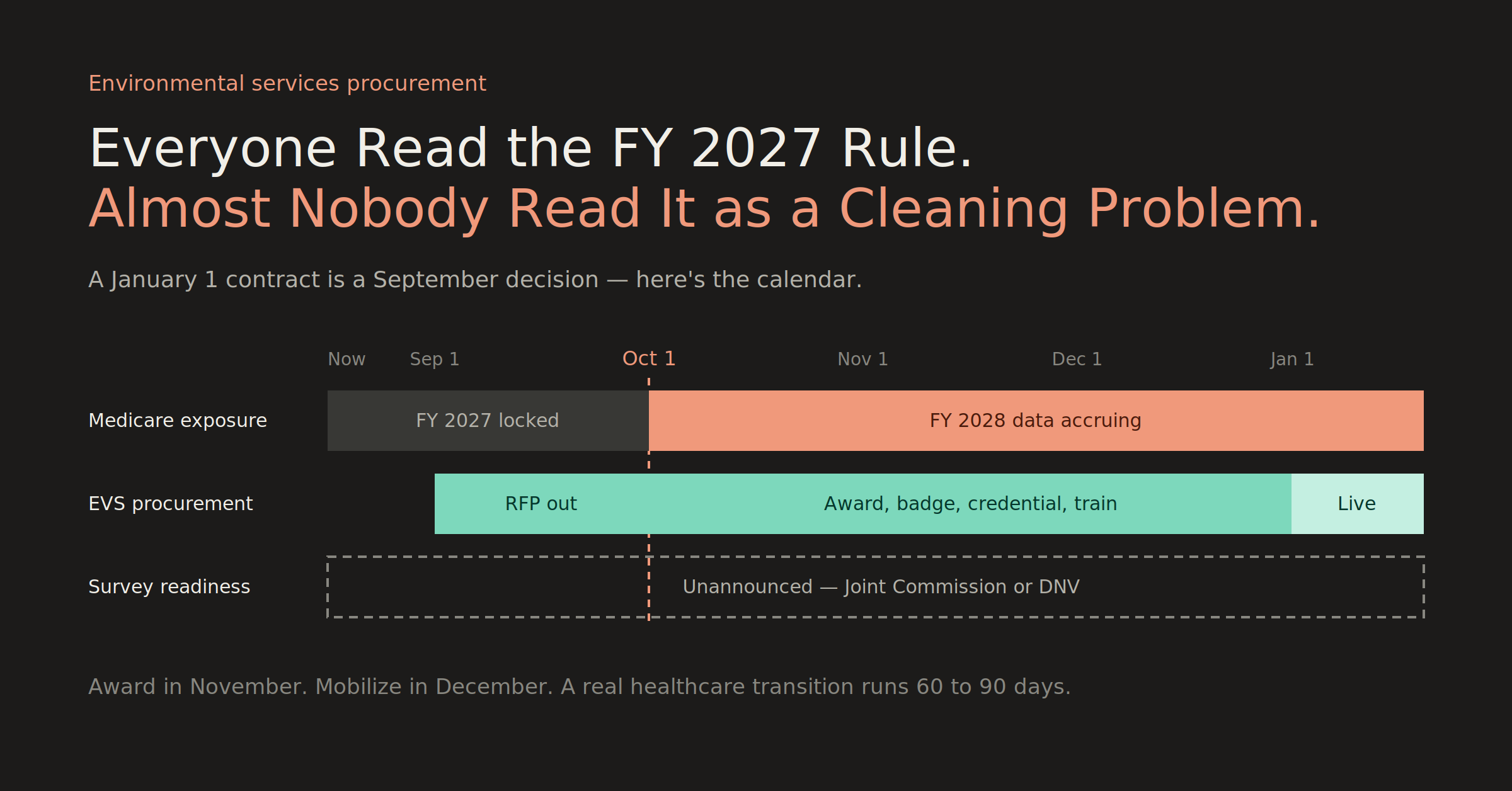
What September changes is FY 2028 — because the data behind that number starts accruing on October 1. The date everyone is treating as a deadline is actually a start line.
Which raises a question worth asking before it arrives: what in your organization is generating that data, night after night, that you currently manage as a commodity?
For a lot of health systems, the honest answer is the cleaning contract.
That's not a rhetorical flourish, and it holds regardless of who accredits you. Both major accrediting organizations moved their physical environment requirements in the last eighteen months — The Joint Commission by consolidating two chapters into one, DNV by revising the standards its annual surveys run against. Different mechanics, same direction of travel.
The second-order effect is this: the physical condition of your building is being evaluated under a tightened, CMS-aligned framework — and the people best positioned to see problems first are the ones your organization is most likely to have bought on price.
Three clocks are running
They converge inside the next hundred days.
October 1 closes nothing. It opens the performance window that sets next year's number.
October 1. Covered above, but worth stating plainly in budget terms: hospitals in the worst-performing HAC quartile hand back a full percentage point on every Medicare fee-for-service discharge for the year. Not on infection-related claims. On all of them. For a hospital with $150 million in annual Medicare revenue, that is $1.5 million, recurring for as long as the hospital stays in the bottom quartile.
January 1. If your environmental services contract runs on the calendar year, the RFP needs to be on the street in September to award in November and mobilize in December. A real healthcare EVS transition — badging, credentialing, transmission-based precaution training, site-specific SOPs, shadowing on your isolation units — is a 60- to 90-day process. Compress it into 30 and you are buying a January staffed by whoever was available on short notice. That is the single most common way a technically sound vendor selection turns into a bad first quarter.
The survey cycle. This one depends on your accreditor, and the difference matters more than most facilities teams price in.
If you're accredited by The Joint Commission, Accreditation 360 has been live about eight months. Surveys arrive unannounced inside a triennial window, so some organizations have now been surveyed under the Physical Environment chapter and many have not. If you're in the second group, your first PE survey is somewhere in the next two years and you will not get notice.
If you're accredited by DNV, there is no window to be inside of. DNV surveys annually and unannounced, with accreditation renewed on a three-year cycle contingent on passing each annual survey. There's no off-cycle year to coast through and no ramp-up period to schedule. Your environmental hygiene program is either survey-ready in March and July and November, or it isn't.
Either way the practical requirement is the same, and it isn't a project. It's a standing condition.
There's a fourth clock that doesn't appear on any regulatory calendar: respiratory season. Whatever your environmental hygiene program looks like in December, you built it in September.
What changed — and it depends who accredits you
Roughly four in five accredited hospitals sit with The Joint Commission or DNV. The Medicare exposure above is identical either way. The compliance mechanics are not.
If you're a Joint Commission organization
The chapters merged. Environment of Care and Life Safety were retired and replaced by the Physical Environment (PE) chapter, with selected requirements moved into a new National Performance Goals chapter. The consolidation was substantial — several hundred elements of performance across the old EC and LS chapters compress into a fraction of that number under PE and NPG. The Joint Commission has been explicit that this introduces no new expectations. The substance carried over. The structure did not.
The survey report is now ranked by risk. Findings are ordered by SAFER Matrix placement rather than alphabetically, which means the highest-likelihood, widest-scope problems appear at the top of the report your board reads.
And — this is the one that should be on your radar — Life Safety surveyors now visit offsite business occupancy locations. As of mid-2025, if a clinical surveyor visits one of your off-campus sites, a Life Safety surveyor goes too. Your medical office buildings, your imaging suites, your urgent cares, your ASCs — the sites that used to sit comfortably outside the survey spotlight — are in scope.
If you're a DNV organization
Your cadence is the standard, not the exception. DNV has held full CMS deeming authority since 2008 and is now the second-largest accrediting organization for acute, critical access, and psychiatric hospitals, with more than 1,000 accredited organizations. Its NIAHO standards are built directly against the CMS Conditions of Participation, and the current revision — 25-1 — took effect in September 2025. Findings are written as nonconformities in categories rather than as requirements for improvement.
And the piece most cleaning vendors have never read: ISO 9001. DNV is the only hospital accrediting body that embeds ISO 9001 quality management compliance into accreditation, phased over three years, covering document control, process improvement, and leadership accountability.
Clause 8.4 of ISO 9001 governs the control of externally provided processes. An outsourced environmental services function is an externally provided process. Which means a DNV-accredited hospital carries a documented obligation to define requirements for its cleaning contractor, evaluate and select against those requirements, monitor performance, re-evaluate, and retain records of all of it.
Read that again as a facilities director. Your accreditor doesn't merely permit vendor due diligence. It requires you to be able to produce the file.
Most health systems can produce a signed contract and an invoice history. That is not a supplier control record. If your EVS vendor cannot hand you documented performance criteria, monitoring results against them, and evidence of corrective action when they weren't met, the gap isn't in their service. It's in your quality management system.
Where both roads meet
Two accreditors, two frameworks, one shared reality: the physical environment is surveyed against CMS-aligned requirements by someone who arrives without warning, and the evidence that your program works is documentary. Nobody grades the mop. They grade whether you can prove what it touched, when, with what, and who checked.
That collides with the biggest structural trend in American healthcare.
The risk is migrating into buildings that weren't designed to carry it
Roughly 72% of surgical procedures in the U.S. were performed in outpatient settings by 2025, up from about 55% a decade earlier, with projections approaching 80% by 2030. Medical outpatient building occupancy hit a record 92.7%, and health systems accounted for close to half of all medical leasing activity — with expansion concentrated in large multispecialty clinics in the 40,000 to 60,000 square foot range.
Virginia is a case study. Inova broke ground on two Northern Virginia hospitals projected at $2 billion across more than 1.4 million square feet. VCU Health is expanding pediatric acute care capacity in Richmond and moving on a dedicated cardiovascular outpatient pavilion. HCA is building an ambulatory surgery center in Ashland. Sentara is completing a new acute care hospital in Halifax. Every one of those projects generates clinical square footage that has to be cleaned to a clinical standard — and much of it sits in buildings that, from a real estate and facilities standpoint, are managed like commercial office.
Here's the failure mode we see constantly: a health system signs a Class A office cleaning spec for an outpatient building where invasive procedures are performed. Nightly trash and vacuum. A day porter. Restrooms twice. Nobody wrote in terminal cleaning protocols, disinfectant contact times, isolation precautions, or a documented high-touch surface schedule, because the building was leased under a real estate process, not a clinical one.
Then a surveyor walks in — and under either accreditor, that building is in scope.
Why the CFO should care, not just the infection preventionist
Environmental hygiene has historically been argued on clinical grounds. That argument is correct, and it is also incomplete — because it doesn't reach the person who approves the budget.
The financial version is straightforward. Under the CMS Hospital-Acquired Condition Reduction Program, hospitals in the worst-performing quartile nationally receive a 1% reduction on all Medicare fee-for-service payments for the fiscal year — not just on claims related to the infection. Five of the six measures that build the Total HAC Score are healthcare-associated infections reported to the CDC's National Healthcare Safety Network: CLABSI, CAUTI, colon and abdominal hysterectomy surgical site infections, MRSA bacteremia, and C. difficile. The sixth is the PSI-90 patient safety composite.
Because the program is structured around a fixed percentile rather than an absolute threshold, roughly one in four eligible hospitals lands in the penalized quartile every single cycle. It is not a program you can exit by being adequate. Someone occupies the bottom quartile every year by design.
And on the question of what actually moves those numbers, the evidence is less exciting than the vendor pitches suggest. A 2026 review out of Duke's Disinfection, Resistance, and Transmission Epidemiology lab examined continuous disinfection technologies — light-based systems, low-level chemical dispersal — and found antimicrobial activity under controlled conditions but inconsistent effectiveness in real clinical environments. The conclusion was blunt: optimizing routine environmental cleaning practices remains the most effective and immediately actionable strategy available.
Not the emitter. Not the robot. The routine.
Which means the variable that determines whether your environmental hygiene program works is the same variable that determines whether any labor-intensive service works: who is doing the work, how well they were trained, and whether they're still there in six months.
The labor math nobody prices into the bid
The Bureau of Labor Statistics counted roughly 2.2 million janitors and cleaners as of May 2025, at a median wage of $17.71 an hour. Employment in the occupation is projected to grow about 2% through 2034 — yet the field generates approximately 351,300 openings every year. Almost all of that is replacement demand. The industry isn't growing. It's churning.
Two details make this worse for healthcare specifically.
First, contract cleaning companies compete for labor against employers who pay more. BLS wage data shows the contract-cleaning category paying meaningfully below hospitals and local government for the same occupational code. A building service contractor bidding at the market floor is, by definition, staffing your facility with people who have a better-paying option down the street.
Second, turnover varies enormously by operator — and that variance is the whole ballgame. Industry benchmarking shows a wide distribution: a large share of contractors report annual turnover above 50%, while a meaningful minority hold it under 10%. That's not a rounding difference. That's the difference between a team that knows your isolation rooms and a stranger with a badge and a cart.
You cannot train your way out of 50% turnover in an environment where competence is measured in dwell times and precaution protocols. You can only hire your way out of it — which is a pricing decision made at contract signature, not a management decision made later.
Seven questions to ask before you sign
If you're rebidding environmental services this year, or auditing an incumbent, these separate serious operators from the rest quickly.
1. Name my accreditor and my current standard revision. A Joint Commission shop should say Physical Environment, not Environment of Care, and their SOPs and rounding tools should already be re-papered to PE numbering. A DNV shop should know NIAHO 25-1 and be able to talk about where they fit in your ISO 9001 supplier control process. A vendor who doesn't know which accreditor you use is telling you something.
2. Is my outpatient portfolio on the same specification as my main campus? Joint Commission Life Safety surveyors now visit offsite business occupancy locations, so a two-tier standard across your portfolio is direct survey exposure. Under DNV, a documented process you apply inconsistently across sites is a quality management system problem in its own right. Ask to see the specs side by side.
3. How do you verify cleaning — not inspect it? Visual inspection tells you a room looks clean. ATP bioluminescence and fluorescent marking tell you whether high-touch surfaces were actually contacted. Ask what percentage of high-touch objects are audited, on what interval, and by whom. If the auditor reports to the same supervisor whose crew is being audited, the number is decorative.
4. What is your annualized turnover on accounts like mine? Ask for the number. Ask for it by site. A vendor who can't produce it doesn't track it, and a vendor who doesn't track it can't manage it.
5. Who is credentialed, badged, and trained on transmission-based precautions — and where is that documented? Not "our staff are trained." Which staff, on what date, verified how, retained where. Survey-ready means retrievable during the survey.
6. How do you prove contact time compliance? Every EPA-registered disinfectant has a label-specified wet contact time. Most field failures are dwell-time failures. Ask how the vendor trains it, audits it, and corrects it.
7. What happens when a tech notices a stained ceiling tile at 2 a.m.? Surface deficiencies in patient care areas, storage encroaching on sprinkler clearance, blocked egress, expired eyewash stations — these are recurring physical environment findings, and your night crew walks past all of them. A cleaning program with a documented escalation path turns 40 sets of eyes into a continuous rounding function. A program without one turns them into witnesses.
One note on certifications
Third-party validation helps, but the acronyms aren't interchangeable, and vendors count on you not knowing the difference.
CIMS Advanced by GBAC (ISSA's Cleaning Industry Management Standard) requires an independent assessor to conduct an on-site evaluation — visiting offices and customer sites, reviewing documentation, interviewing staff. Certification runs two years and must be re-earned.
GBAC STAR Service validates a contractor's cleaning, disinfection, and infection prevention protocols against 20 program elements. It is a documentation-based review without an on-site audit.
Both are worth having. They answer different questions. A contractor holding both has demonstrated that the documented system exists and that someone independent watched them run it.
The reframe
The organizations that navigate this well aren't the ones that found a cheaper vendor. They're the ones that stopped treating environmental services as a facilities line item and started treating it as what it functionally is: a distributed, continuously operating risk control function that happens to also clean.
Your EVS team is in every room, every night, more often than anyone else in the building. Under a consolidated Physical Environment framework, with surveyors now reaching your offsite locations and a fixed-percentile Medicare penalty waiting for the bottom quartile, that team is either your earliest warning system or your largest unmanaged variable.
It is rarely neither.
The FY 2027 number is already written. The FY 2028 number starts accumulating in five weeks, in rooms that get turned over tonight by people someone hired at a wage set in a contract someone signed a year ago.
That's the part still in your control. For about another month.
Office Pride Commercial Cleaning Services provides environmental services to hospitals, ambulatory surgery centers, outpatient facilities, and critical environments across Virginia. If you're scoping a January 1 contract or opening a new site this year, we'll walk your facility and give you a written assessment of your current program against your accreditor's standards — Joint Commission PE or DNV NIAHO.
Sources
- The Joint Commission, Accreditation 360 — Physical Environment chapter resources: jointcommission.org
- Environmental Health & Engineering, "Joint Commission's Physical Environment Survey Process and Accreditation 360": eheinc.com
- J. J. Keller, "What to Know About the Joint Commission's Accreditation 360 Standards": jjkellerconsulting.com
- CMS, Hospital-Acquired Condition (HAC) Reduction Program, FY 2026 Fact Sheet: cms.gov
- CMS, FY 2027 IPPS/LTCH PPS Final Rule (issued July 31, 2026; published August 4, 2026; effective October 1, 2026): cms.gov / federalregister.gov
- Warren et al., "Continuous and enhanced daily disinfection strategies to reduce environmental contamination in healthcare settings," American Journal of Infection Control, 2026
- JLL, 2026 Medical Outpatient Building Perspective: jll.com
- Virginia Business, "Health care systems are in their building era": virginiabusiness.com
- U.S. Bureau of Labor Statistics, Occupational Employment and Wage Statistics (May 2025) and Occupational Outlook Handbook, Janitors and Building Cleaners
- ISSA, CIMS Advanced by GBAC and GBAC STAR Service program documentation: issa.com
- DNV Healthcare, NIAHO accreditation for acute care hospitals and NIAHO Accreditation Requirements Revision 25-1: dnv.com
- ISO 9001:2015, Clause 8.4, Control of externally provided processes, products and services